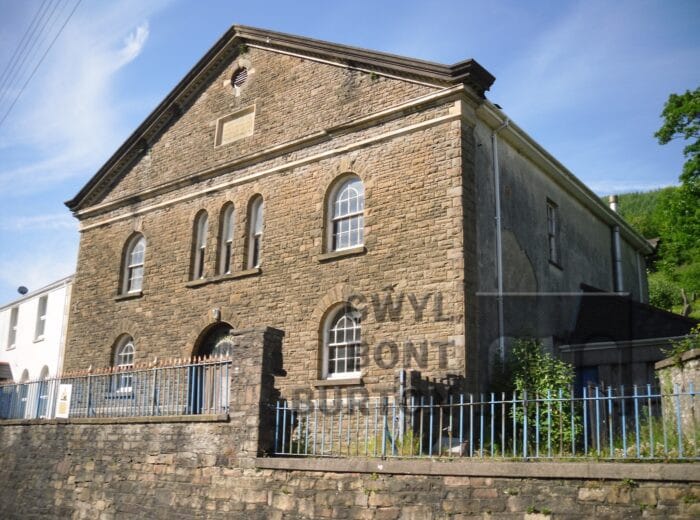
The history of chapels in Wales is closely tied to the rise of non-conformism which grew significantly from the 17th century reaching a peak
The history of chapels in Wales is closely tied to the rise of non-conformism which grew significantly from the 17th century reaching a peak in the 19th century with large numbers of chapels being built. Pontrhydyfen was no different. Several chapels of different denominations could be found in and around the village and provided a strong sense of community, providing social and educational events. Services were usually conducted in Welsh rather than English.
Often, chapels provided the opportunity for adults and children to become literate through Bible meetings and Sunday schools as well as the chance to enter singing, literacy competitions and eisteddfodau.
As you will see from several newspaper reports, chapel deacons held a lot of influence and power within the community and could be found commenting upon the behaviour and political leanings of their flock which were often reported in the newspaper! This is only a brief outline of religious churches and chapels of the village & surrounding area.
Once again, if you have further information, please let us know via the contact us form.
Sardis Welsh Congregational Chapel:
Prayer meetings were started in and around Efail fach by a number of members of the Rock Chapel, Cwmafan and Fforchdwm, Tonmawr. However, members complaining of the distance they had to go to worship took it upon themselves to start building work, often using stones from the Pelenna river to construct their own chapel. Building started outside the parish boundary in 1856 and completed in 1859.
It opened on 3-4th August that year. It is thought that it was modified or altered in 1896 and 1905. Seating 400, Sardis now gives its name to the steep hill above the old mill site in Efail Fach. It closed in the 1980’s and much of its interior was moved and installed in Machpelah chapel.
Capel Jerusalem:
The site of the oldest chapel and graveyard in the village of Pontrhydyfen. Jerusalem was a Calvinistic Methodist Chapel. Successive buildings have been built on this site (1845 & 1876). The present building is a Grade II listed and was able to seat 800 people. It was designed in the classical style by the Rhondda architect W. Jones and built by E. Evans, Llangynwyd. It closed in the 1990’s and is now a private residence.
Bethel Baptist Chapel:
The first Bethel chapel was built in 1850 but rebuilding and modifications took place in 1903. It is thought that some of the earlier building was incorporated into a boundary wall. It is a Grade II Listed building and was in the global spotlight when the memorial of Richard Burton was held in there in August 1984. Although the chapel has since closed, it has now reopened and operates as a café and music venue. Much of the interior has been retained and the baptismal tank has been retained and can be found under the stage.
The first Bethel chapel was built in 1850 but rebuilding and modifications took place in 1903. It is thought that some of the earlier building was incorporated into a boundary wall. It is a Grade II Listed building and was in the global spotlight when the memorial of Richard Burton was held in there in August 1984. Although the chapel has since closed, it has now reopened and operates as a café and music venue. Much of the interior has been retained and the baptismal tank has been retained and can be found under the stage.
Capel Gyfylchi:
A chapel or church has probably stood on this site since medieval times, but by the mid-18th century it was in ruins. A Methodist clergyman William Davies started to rebuild it in around 1775. Gyfylchi became an important centre for the Methodist and Revivalist movement. Many preachers came to meet at Gyfylchi and these could attract crowds of several hundred. To accommodate this number of people, construction of a new Methodist chapel (Jerusalem) was started in 1824 and the building was completed in 1826.
Macpelah Chapel (now Sardis-Macpelah):
Opened in 1896 and was used as a vestry and Sunday school for the congregational Sardis chapel. Found alongside Macpelah cemetery, this became the main chapel for the Congregationalists when Sardis closed in the 1980s. Pelenna Community Council took over the running of the cemetery in 2015. This is the only chapel offering service in Pontrhydyfen.
St John the Evangelist Church, Oakwood:
Anglican services were originally held in the old school room in Oakwood. The land and funds to build the church and school was donated by the Talbot family. The church was opened in 1882 (see newspaper article) and was the mother church for residents of Oakwood, Tonmawr, Bryn and Pontrhydyfen.
St Teilos Church Mission Hall, Tonmawr:
The current building was erected when residents got together and raised funds to build a new St Teilo’s when St John’s church was closed in Pontrhydyfen. It was consecrated in August 2003
Early records indicate that congregational meetings were held in a house called Shiloh in Tonmawr. It is not certain that this was the precursor to Bryn Seion Congregational chapel, which was referenced in 1847 and the building modified in 1883, 1895 and again in 1910. Records stated that the building held seating for 350 people.